We live in a world where great powers are increasingly assertive about their spheres of influence. Military fashion is an extension of these great power politics. Observe how every other army wants to dress in MultiCam fatigues like American special operators taking down annoying regional autocrats–even when trying to keep America out of their own sphere. That’s soft power.
This paradoxical pattern also appeared during the Age of Imperialism. Back then, khaki drill was the original camouflage, and pith helmets were just as universal as Ops-Core helmets today. The pith helmet was the headgear of the hegemon, and was emulated by everyone trying to either bandwagon or balance against them.
Any enterprising think tanker shall surely be tempted to rescue an iconic pith helmet from the attic of a stately pile and put it on as their head as they go into the field. But which one to choose? To help, DARC has asked your humble correspondent, on the basis of his extensive military experience and correct sense of style, to share his advice on picking the right pith helmet.
If you are headed out to conduct defense analyses and looking for a robust tropical version of Conservative Business Dress, look no further. Read on for our considered advice.
The Foreign Service Helmet
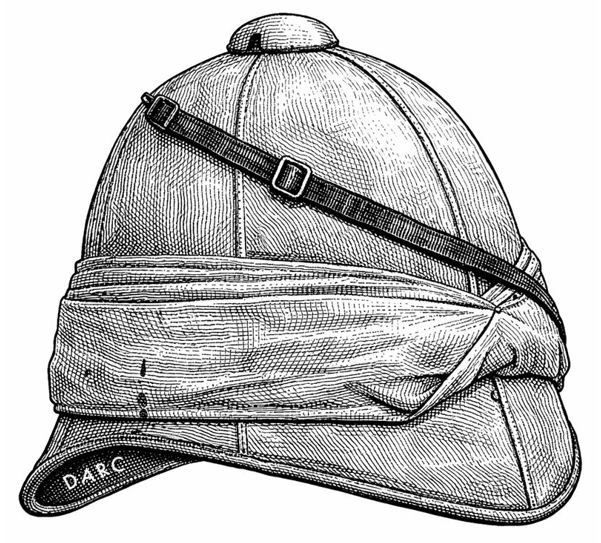
The helmet: After suffering devastating losses to sunstroke during the Indian Mutiny, the British Official Mind decided to protect its troops from solar threats with big hats. It developed an elegant helmet, inspired by antique Roman forms, with a domed top and rakish brim. Although initially made of the dried pith material of the plant Aeschynomene indica, in fact it was more often made of cork. This “foreign service” pattern helmet was spirally developed from the 1860s onward, as described in incredible detail in C.P. Mills’ history Jaunty Hat.
When to wear it: Sport a classic foreign service helmet in khaki for Victorian colonial warfare in Afghanistan or Africa, or in white for Indian durbars. If serving as a viceroy, accessorize with a gilded spike, swan-feather plume, and colorful silk pagri.
Shop the look: Amazingly, copies of the foreign service helmet are still made today in Vietnam. (Even more amazingly, the Vietnamese army still wears rather counterrevolutionary pith helmets.) However, Vietnamese pith helmets are costume pieces, best suited for wear at colonials-and-natives-themed fancy dress parties, or sitting on the couch watching ZULU. For more muscular activities, we recommend sourcing a vintage pith helmet from dealers like Johnny Hogspear or the Cary Collection. Keep an eye out for classic brands such as Ellwood, Hawke, or Ranken of Calcutta. The French, Germans, Spanish, Portuguese, and even the Americans all copied the foreign service helmet in its prime, but there is no substitute for the British original.
The Wolseley
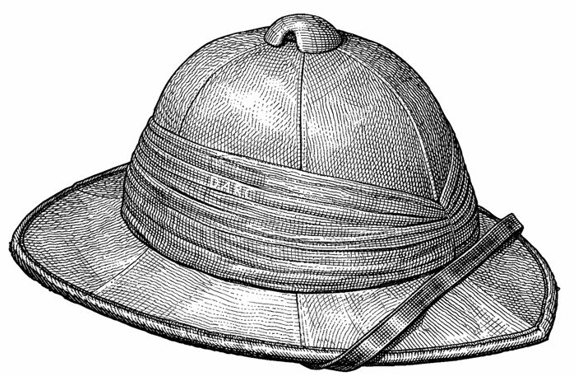
The helmet: As the British Empire absent-mindedly stretched across the globe, colonial governors and soldiers required an even bigger helmet to protect them from the equatorial sun. This resulted in the adoption in the 1890s of the “Wolseley” helmet, named after legendary Field Marshal Sir Garnet Wolseley. It is shorter than the FS helmet and has a broader brim. It became popular abroad, and President Teddy Roosevelt wore British-made Wolseley helmets when he wasn’t outfitted in felt cowboy hats. The Wolseley helmet remains in limited use today for ceremonies in Britain’s overseas possessions.
When to wear it: Don a Wolseley in khaki for late Victorian and Edwardian colonial warfare, such as mowing down Soudanese with Maxim guns or rounding up Boers on the veldt. In white, it looks great for partition ceremonies.
Shop the look: The Vietnamese make copies of Wolseleys too, but again, no burden-bearing character would be caught dead in a Vietnamese pith helmet. Your best bet is a vintage helmet from a shop like Brooklyn’s based Crowley Vintage. Wolseleys have been worn throughout the British Empire for over a century, so they are much easier to find than foreign service helmets. Pro tip: Before buying a vintage Wolseley, check the label to be sure you are getting a regulation British pith helmet. Canadians wear Wolseley helmets of tawdry quality.
The Bombay Bowler
The helmet: The Bombay bowler is a 20th-century classic. With a flat top and short brim, it’s less likely to fly off your head while charging into battle or galloping after a boar. It is made in India from authentic pith material. The Bombay bowler is derived from the Cawnpore Tent Club Hat, a larger version popularized by the Prince of Wales during his 1875-6 visit to India. These hats came into wide use around the time of the Great War and by the Second World War were the most common military helmets.
When to wear it: Strap on a Bombay bowler for equitation in the tropical zone. It is the ideal helmet for polo and pigsticking. This is the leather football helmet of horsey headgear, with equivalent capability to prevent traumatic brain injuries.
Shop the look: Bombay Bowlers remained in production long after the fall of the Raj, and vintage examples are easy to find on Etsy and eBay.
The American Sun Helmet
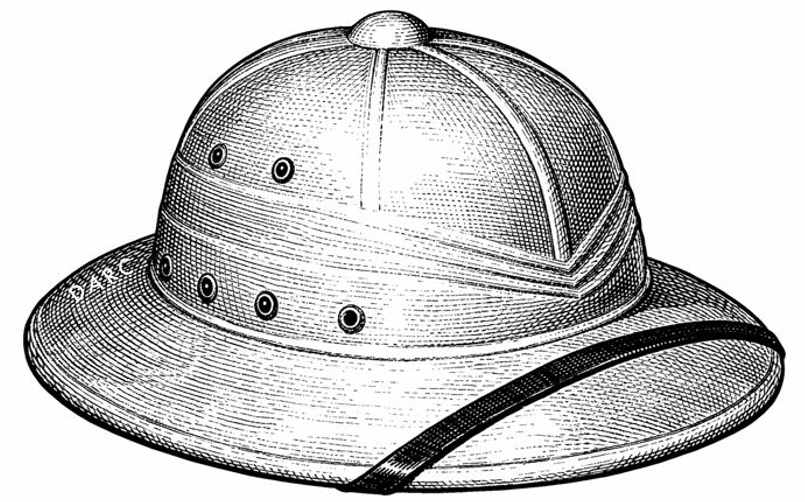
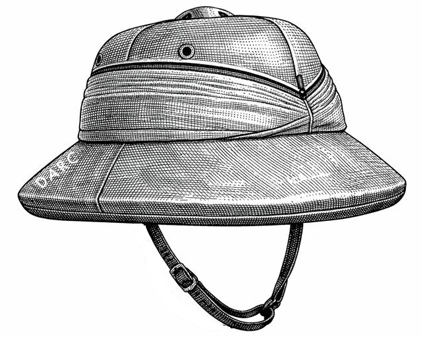
The helmet: Like most imperial powers, the United States ripped off the British foreign service helmet in the 1880s. These early American helmets are more bulbous and uglier than their British counterparts. American pith helmet makers continued to imitate British trends poorly with the “helmet, sun, rigid, fiber” adopted in 1940, inspired by the British “Standard Pattern” solar topee. U.S. Marine Corps marksmanship instructors continue to wear these pressed fiber sun helmets today. These sun helmets are also famously popular with rich women, from Mrs. Thurston Howell to First Lady Melania Trump.
When to wear it: Per Marine Corps uniform regulations, the American fiber helmet can be worn “if authorized by the Commandant of the Marine Corps…at posts where climatic conditions warrant its use.” It may also be worn by fashionable trophy wives on safari.
Shop the look: Ask your supply sergeant or image consultant.
Help! I Can’t Find An Applicable Helmet
Readers may find that the only scenarios listed here that they are likely to encounter are polo and colonials-and-natives fancy dress parties. Victorian colonial warfare is harder to find than it used to be. This is not accidental. As Nicholas Antongiavanni once wrote, the well-dressed man “should aim…to emulate the dandies of old, while honoring the conventions of our time.” Tragically, by the conventions of 2026, anyone wearing a pith helmet risks being mistaken for Col. Mustard or a Jumanji cosplayer.
That does not mean we advise immediately tossing your pith helmet into the Suez Canal. We remain hopeful that forward deployed think tankers of all stripes will restore this bold imperial fashion tradition. Still, we advise caution when picking a pith helmet. If worn without the necessary vigor and prestige, it’s going to make you look ridiculous.