
Drawing on three weeks of fieldwork in Bogotá, Antioquia, and Chocó during the first weeks of the Espriella administration, this report argues that Colombia’s war is best understood not as a counterterrorism campaign against a handful of armed groups, but as a much older kind of problem: a contest for territorial control, in which the state must take, hold, and govern ground it has never fully reached. American support should be built around that older military paradigm – and the unglamorous, attritional capacity it demands – rather than around the tools and tech of contemporary counterinsurgency doctrine.
This paper proceeds in three parts: first a field report, then a proposed reframing of how the US thinks about counter-cartel action, and ending with proposals on what tactics, technology, and policy should be pursued in the Colombian theater for long-run success.
I. Field Report
Two days prior to the inauguration of Abelardo de la Espriella, all color had drained from Bogota. The outgoing president, Gustavo Petro, had called for everything short of armed insurrection – declaring the election illegitimate and blaming the US. The ceremony itself had to be moved from the seat of government to the commercial city of Cali, along with some third of the Colombian military. As soon as the sun dipped below the capital’s mountains that night, the once-lively streets cleared and windows – many already behind razor wire – closed, their curtains drawn. Over nine hundred pounds of explosives hidden in a bus, destination Cali, had been seized that day, just as the Petrist Left reached a fever pitch on social media. The US embassy closed its doors and issued security alerts for the inauguration, warning of potential riots and armed action.
Colombia had reached an inflection point, with an unprecedented outsider President-elect and an uncertain – but hopeful – future. Espriella promised public safety, realignment with the US, economic prosperity, moral reform, and most of all, war with the cartels: the platforms of Trump, Bukele, and Milei merged into one, with a distinctly warlike, righteous flair. El Tigre, Defender of the Homeland – that was the image, and the promise was no longer “Total Peace” but total victory.
At the center of this proposed campaign was American cooperation and technology, a sort of revived approach to Plan Colombia aimed at disrupting the insurgents that had plagued the nation since 1948. Colombian history since then has been a continuous tapestry of shaky governance supplanted by non-state actors exerting military influence, especially in the countryside. La Violencia – a decade-long rural conflict along partisan lines, so bloody that its refugees drove rapid urbanization – gave way to permanent radical-left insurgent groups. Then, the dawn of the cocaine boom pumped billions of foreign dollars into illicit markets. Soon, a pattern emerged of fighting governments followed by negotiating ones, neither quite able to seize control over their own territory even as the military grew in size and capacity. Along with this change came rural civilian populations increasingly either dependent upon or under the control of armed groups, bolstered by American attacks on the drug trade that seemed only to deepen those ties.
Last year, the Global Organized Crime Index ranked Colombia the second-most-criminal nation in the world, behind only Myanmar. Cartels and insurgents have been a part of the Colombian surround nearly as durable as major sectors like coffee or bananas; a campaign against these groups would, if successful, leave the country unrecognizable. On the eve of Espriella’s inauguration, the fear of retaliation from them was palpable. Further, Colombia’s elite were still reeling from the election results, even months after the vote. “Nobody expected this” stood out as the common refrain among urban professionals. However, an Evangelical groundswell for the outsider candidate, plus votes from expat hubs like Florida, helped break a two-hundred-year run of the President being drawn from a narrow party establishment – and to reverse a recent leftward turn that, from the voters’ perspective, deeply harmed daily life.
The promised riots never came. The military presence in Cali was successful at deterring an attack, and the Left lost its nerve for the street rioting or blockades of recent years. Protests attracted only a straggling crowd, and the Plaza del Bolivar displayed more flyers about Palestine than Colombia’s own political overturning. The mood in Bogota (and online) shifted toward jubilance, especially as military operations began. The first three days saw successful operations against 10+ FARC dissident leaders, bombings of ELN encampments and logistical hubs, and a half-dozen more notable military engagements, each in favor of the government.
This momentum, however, was interrupted by a 7.4 magnitude earthquake, devastating Cali and broader Cauca only three days into the new government. Even Bogota, 200 miles away, shook considerably and activated an emergency response. With over three hundred dead and uncountable missing, significant military resources had to be diverted to relief, and media attention centered around a series of scandals involving Petro appointees reportedly denying international help as a form of political sabotage. The campaign against the insurgents continued in force, but the bulk of resources and attention (understandably) shifted to the disaster site.
The earthquake, more than anything, demonstrated how sorely vulnerable Colombia is, in terms of both infrastructure and governance. The same longstanding structural problems that make it a difficult military theater to stabilize – insufficient public investment, thin governmental services, and lacking rural logistics – are painfully highlighted by such events.
And these problems are indeed structural, having shaped Colombia’s development for its entire history. Its difficult, mountainous geography historically made transport expensive and cumbersome – slowing industrialization and modernization, especially outside the major cities. National business cycles have been defined by dramatic boom-and-bust export crazes, with neither liberalization nor protectionism succeeding in stabilizing the markets long enough to develop a modern economy until quite recently. While Colombia has been at times cast as the “moderate counterweight” to neighboring Venezuela, in reality it has maintained that “moderation” only via a detente born of vicious partisanship – the same conflict that began its modern instability eight decades ago, and the same conflict that complicates basic state functions like disaster relief today.
Further, the urban-rural divide is stronger than perhaps anywhere else in South America, and even today you will see members of the political class diagnose Colombia as a collection of major cities – Bogota, Medellin, Cali, Cartagena – surrounded by “los territorios,” a Wild West of loosely-connected countryside that has always somewhat handled its own affairs. David Bushnell, author of The Making of Modern Colombia, calls it “a nation in spite of itself:” an apt description, especially considering the sheer durability of the state as a single entity, and the pride and unity its flag inspires in its best moments. Through each one of Colombia’s crises – from the 1839 War of the Supremes to the Thousand Days’ War, to Escobar’s 1980s attempts to run a protection racket on an entire state – it has remained Colombia. The question, as ever, is how to address the structural problems that have made so much of its territory near-impossible to govern.
The Espriella administration’s answer is not terribly different from the early Colombian government’s answer to a distributed insurgency in 1839: superior political alignment and will, and strategic international alliances. In this case, the goals – atop the main military effort – include cutting off backchannel insurgent organizational hubs like permissive prisons, shifting away from Chinese infrastructure investment, and leaning heavily into American security/intelligence cooperation.
There is a particular optimism around using American technology to modernize the Colombian state. The political donors we spoke to were particularly interested in replicating Palantir’s work with the UK NHS and US DHS/ICE, as well as the broader Tech Force model underway in the US federal government. For a state lacking governmental capacity, frontier software projects offer the ability to cut bureaucratic sinecures while actually expanding state capacity, and particularly institutional legibility.
This emerged as a common theme across domains: a sense of optimism for solving Colombia’s long structural problems with disruptive technology and radical reform. Jungles and mountains need not be the barriers to logistics they once were, and distributed rural populations need not be cut off from communications or services by their location; advanced ISR and SIGINT can significantly cut down the information advantage of backcountry insurgents; military success in a given region can lead to infrastructure capital deployment faster than ever before; etc. The later sections of this paper recommend a strategy of attritional warfare combined with policy aimed at bolstering state legitimacy – with recommendations for how to implement this across military strategy/technology, force posture, US foreign aid, and collaborative approaches to transnational crime.
The remainder of our trip left Bogota to observe a region of low state presence in person: Uraba-Choco, the Colombian side of the Darien Gap. Traveling by way of Apartado (in Antioquia), we made our way to the Gulf of Uraba and its surrounding towns, classically the center of Gulf Clan activity and a major source of go-fast boats on the Caribbean side of the isthmus. There, small beach towns pop out of thick jungle – the land behind which is dotted with small indigenous farms, eventually yielding to massive banana plantations cut into once-densely-forested valleys.
The towns themselves are quaint and touristy, connected by a new highway project and frequent bus routes. The area between them, however – despite being so connected to commerce – is more reminiscent of the unevenly-modernized Panamanian Darien, described at length in The Second Southern Border, than anything resembling “development.” In Necocli, you can sit on the beach and be served ceviche by a Rastafarian blasting reggaeton; two miles away, Guna families live in thatch-roof huts with waist-height walls. The area in between has classically been a haven for the construction and launch of go-fast boats, used to smuggle cocaine. The dense mangroves and canopied streams provide perfect shelter for the deployment of these vessels. Police presence is already thin in Necocli, and only gets thinner from there, as further towns on the Gulf are reachable only by boat.
A two-hour boat ride at breakneck pace took us out to the largest town without road access: Capurgana. Despite the beach-town feel of the main street, it is here that the sheer lack of state presence becomes obvious. Power is intermittent, more often off than on; reception is practically nonexistent. The police are nowhere to be seen, but teenage spotters stand at the docks to count each boat that comes and goes, and log its passengers. Leave the main street and you’re quickly stopped and interrogated as to what you’re really looking for; even the Colombian tourists stay on that block.
Later that night, after watching a band play Welcome to the Jungle in broken English – a surreal scene – I finally spot the fabled cop. He is standing at the precise edge of “downtown,” Galil gripped tightly, finger on the trigger. Less than a hundred yards away is a pirate-themed beach bar, but he looks like a soldier outside the wire. In a way, he is; the Gulf of Uraba is the nexus of Plan Pistola – an open bounty on police officers, posted by the Gulf Clan. He ushers me down the street like I’m standing in the crossfire. Later, even with an audible fight down the street, he does not leave his post.
Tourism in the Gulf has picked up recently, in part to supplant its now-lost migration industry. The majority of trans-Darien migrants (at its peak in 2022) passed through this region, taxed and corralled by Gulf Clan operatives. A boat launched from Necocli or Turbo took them across the Gulf, where the trek began to the headwaters of, for example, the Tuquesa River – where native guides would take them by canoe to a UN reception center in an Embera town. It was at this point that EGC presence was most visible, due to the influx of people; however, the governance established during this time has not left, only become subtler.
This is still the situation in Uraba: the land and people are governed, just not by the government. There is law and norm enforcement, commercial dispute resolution, access to credit, basic services, etc. – all provided by various criminal groups. Policing is either nonexistent or so cursory that it is practically so; yet the towns are mostly peaceful and managed. In so many disputed regions in Colombia, the thing under dispute is not only a monopoly on force, but a monopoly on legitimacy; where the government is unable to establish itself as the fount of legitimacy, other armed actors step in, with alternate revenue streams and taxation schemes.
Past Capurgana, via a jungle trail or boat ride, is a quieter town that epitomizes this: Sapzurro. A small fishing village, it sits at the absolute edge of Colombia. A steep set of mountain stairs stretches over the border to La Miel, Panama; the border crossing itself is not staffed, but someone demands a $1 bribe at the bottom. A shanty town gives way to a small beach, with pools of open sewage close enough to flush out at high tide. The only building of note is a Duty Free store, from which an unlucky few ferry liquor and cologne over the mountain to Colombia and through the trail to Capurgana; sweat pours from their lowered foreheads as they stomp down the mountain, cases of liquor in trash bags adorning both shoulders. The beach’s “patrons” are exclusively young men, in small boats with unusually large outboards and no fishing equipment. By night, they make their way back to Sapzurro, packing out its only bar. Outside, a speaker the size of a box truck – worth more than any given block of houses in town, and with its own generator – blasts music loud enough for a stadium EDM festival. Girls of no more than fifteen adorn the walls as the men gamble and drink, pointedly turning up the music until we leave.
The key dynamic at play here is a total lack of state presence; that lack of visibility is the vacuum that has allowed the EGC to operate with relative impunity, and to establish itself as the locus of practical governance. Similar dynamics come into play in other contested regions: Arauca, Catatumbo, Cauca, Micay, etc. The state is not facing competition here, but total supplantation – because it was never present in the first place. Colombia’s armed groups have emerged where people are but the state is not; all of their tactics and adaptations have revolved around exploiting the lack of governance in large swaths of the nation’s countryside. In some ways, Colombia’s current dysfunction and security crisis is perhaps a symptom of their lack of advancement past their analogue to the American frontier era. The public infrastructure and government presence that followed our settlement of the West simply has not followed Colombia’s own advance of development into the countryside – which has created space for other armed actors to step in.
II. Reframing American Strategy
Today, Colombia faces three primary insurgent threats – the EGC (Gainatistas or Gulf Clan), the ELN (National Liberation Army), and FARC dissident groups – as well as a number of smaller groups. Framing these groups as distinct entities to be studied and combatted independently is intuitive, and it maps neatly onto the way the United States has learned to think about armed groups since 2001: as defined organizations with leaders to kill and finances to seize. It is also misleading. The decentralization of these groups, and the conditions they exploit, makes it far more productive to think in terms of distinct regional problems, with various enemy forces in each area. The goal, then, becomes to retake the areas, rather than to try and pin down groups which have proven time and time again to adapt so long as the lack of territorial control enables their existence.
The groups themselves are quite heterogenous. The EGC is a transnational business operation of loosely-aligned gangsters responding to market incentives: one part of a complex, illicit economy. FARC’s era of central authority is over, and today its splinters are anything but homogeneous and organized. The ELN uses a franchise model that gives it remarkable durability, relying on corporate extortion alongside Venezuelan state aid (the extent of which is unclear today, but at the very least exists at a local level). Their org structures, revenue streams, and fieldcraft vary widely; but their root causes – and general strategy – are consistent.
On a tactical level, all three organizations have arrived at similar conclusions, born of the paradigm that allows their existence in the first place. The latest convergent evolution is drone warfare. Today, Colombia is second only to Ukraine in volume of drone attacks, with hundreds of strikes so far this year. Cheap, prolific, Chinese-manufactured consumer drones are modified and deployed based on expertise gained in Ukraine, where a number of militants have traveled for training. These attacks have been used to great effect against police stations, military installations, politicians’ homes, and public infrastructure (airports, highway toll booths, etc.) in the past three months alone. They have ranged from one-off bombings to complex swarm bombardment paired with infantry action; in Catatumbo, fiber-optic drones – immune to jamming – are already in use. As seen in Ukraine, videos of these attacks can become potent propaganda.
This new technology, alarming as it may be, is employed as an extension of these groups’ classic mode of operation: the exploitation of one-sided exposure. This has always been the core tactic, and it remains the only major advantage they can exploit when faced with a modern military, as Colombia’s ultimately is. The state is fixed and identifiable: police stations, infrastructure, political leaders, and the like have addresses and public profiles. The armed groups are dispersed, anonymous, and embedded in the civilian population. Drones are simply the newest tool for exploiting that asymmetry, with the lowest risk to the insurgents themselves.
Even insofar as insurgents are identifiable – i.e. in places where they do not make their presence a secret – strategies like Plan Pistola exploit that same one-sidedness, and make policing near-impossible in some areas. On a broader scale, the tactic of paro armado – an “armed strike” – can paralyze commerce and daily life in a region, both stymieing governmental efforts and reinforcing insurgents’ psychological sway over the populace. Underneath all of it sits the insurgents’ primary retaliatory threat: soldiers and politicians involved in counterinsurgency being identified and targeted, or seeing family members kidnapped and tortured. Drones only advance that same paradigm; when they are used to enforce lockdowns in Micay or attack radar systems in Cauca, the threat is the same as ever: “we can see and touch you, while you can neither see nor touch us.”
The “cartel way of war,” then, is to not fight a war – because, as seen recently in operations against the ELN and FARC dissidents, these groups lose every time they are forced into a direct engagement. It is, like any insurgency, to entirely avoid direct confrontation, and solely operate based on a mafia paradigm of implicit personal threat, asymmetrically-costly attacks, and criminal-market-economy adaptation to government actions. In the Colombian case, that mafia paradigm relies on a lack of government presence in places like Uraba. Drones slot neatly into that paradigm, but they don’t define it; they’re more so a fitting addition to the arsenal than a restructuring of the logic of the fight. Currently, EGC/ELN/FARC’s bet is that the structural issues in Colombian governance that allow their existence will outlast the government’s appetite, capacity, and budget to prosecute a high-intensity war against them. For some sixty years, this bet has played out in their favor. Our goal, then, must be to change the game in favor of the government: to create a set of affairs that allows “set-piece” actions against armed groups to do permanent damage, and extends Colombian governance to all parts of its territory. If the cartel way of war is to simply wait it out, the objective of a successful Colombian effort should be to force them to fight, all the while gradually closing the gaps in which the cartels thrive.
It is those gaps that should be the target of any effective Colombian (and thus US) policy, rather than the adversary groups in themselves. Instead of three adversary problems, Colombia has five regional-governance problems – each of which involves clearing out one or more of these three adversaries. The fight is less about “the cartels” and more about taming distinct, long-difficult pieces of (physical and human) geography. Each region demands its own form of military presence, tactics, and infrastructural investment to make real governance possible, and to permanently suppress the formation of guerrilla organizations.
- Arauca
- Seasonally-flooded llanos (rolling plains with long sightlines) with both riverine and road-grid movement; two major oil pipelines, traditionally the targets of ELN extortion-bombings; significant ELN influence in local government
- Catatumbo
- Mountainous jungle with sparse roads, dominated by the ELN which benefits from easy crossings into Venezuela; extensive drone usage, especially fiber-optic; serious threat from landmines
- Uraba-Choco
- Entirely-riverine Darien-like jungle theater practically governed by EGC; plan-pistola attacks on police and politicians; ELN presence, but recently weakened in comparison to the EGC, though with river-shutdown capacity
- Cauca-Narino/Micay
- Triple-canopy Andean forest descending to mangrove estuary; the most drone-heavy theater in the world outside of Ukraine, plus IEDs; the economic center of coca export, and the origin of go-fast boats
- The Amazonian South
- Intense triple-canopy jungle and the home of EMC, the largest FARC splinter faction; four-nation border frontier adds political difficulties to operating; significant hidden logistical hubs in the jungle
Each of these theaters requires a unique approach, but they share two core measures of success: first, how much of each region’s human geography is legible to and engaged with the central government; second, and relatedly, how much of its population views that government as the sole source of legitimacy. As seen in Capurgana, mere police presence is not enough; the state must be visible, permanent, and actually hold a monopoly on force in the eyes of the people.
This is a very different target than the ones the United States has traditionally set for itself in Colombia, and it demands a very different set of metrics. In fact, the US faces something of a trap in optimizing for any of its well-known and loved success metrics. Either “War on Drugs” metrics (the street price of narcotics, etc.) or GWOT metrics (pure org-chart eliminations) would be a bad proxy – and a worse target – leading to ineffective policy.
Traditional War on Drugs metrics – namely, the street price of cocaine in the United States – are poor measures of effective action against Colombian cartels. Supply shocks to the cocaine market barely affect the final price, because the vast majority of value is added after a kilo crosses the US border. Further, stateside demand for cocaine is relatively price-insensitive, so treating a price increase as a target fails at decreasing actual usage – and at disrupting the market in a way that actually harms these organizations. Because the cocaine supply chain is a complex, adaptive market, disruption to any part thereof leads to adaptation, rather than a decrease in product – or any real financial harm to high-level participants. Coca field destruction in Colombia moves production to Peru and Bolivia; crackdowns on processing move those steps to Nicaragua and Guatemala.
The classification of Colombian insurgent groups as terrorist organizations has been an important step in rectifying this approach to counter-cartel action, as has the broader legal shift – now extended to Colombia through the Trump administration’s Americas Counter Cartel Coalition, or the A3C – toward treating their members as combatants in an armed conflict rather than as ordinary criminals. The central players – who enforce contracts and supply the majority of capex – are, ultimately, organizations with members who can be imprisoned or killed. In the Colombian case – at least until its planned CECOT-inspired megaprisons enter operation – the latter is ideal. Because competent human capital willing to work for a cartel is in short supply, permanently removing major players – instead of letting them run operations from behind bars, or train a successor – does legitimate, if impermanent, harm to the operational capacity of the EGC and other groups. The case of “Ojos Azules,” an aged operative of the defunct AUC, still threatening informants from inside a Barranquilla prison, is instructive as to the alternative. Also, attacking the shadow-banking aspect of these organizations (often involving physical transfers of cash and gold, including illegal mining as a form of money laundering) does significantly more damage than broad-spectrum attacks on cocaine production.
However, again, the cocaine supply chain is a market; pure org-chart eliminations cannot permanently stop the production of cocaine. Both decapitation strikes and negotiated Demobilization, Disarmament, and Reintegration (DDR) have been historically ineffective in the Colombian context – the 2016 FARC demobilization deal, for example, ended in its signatories being hunted by dissident members and the ELN, both of whom still operate today. The true goal here should be to fix the structural problems that made Colombia the center of cocaine production: namely, the inability of the state to reach, observe, and govern rural parts of the country; and the lack of licit financial opportunities for farmers in so many places. To this end, an index that truly measures “success” would observe things like municipal and property tax collection, land registration, use of the formal banking system and credit, the rate of unsolved homicides, reports of forceful confinement, etc., as well as coca substitute-crop production.
Isaac Beltrán, a Colombian scholar of organized crime, made a version of this point to us directly. Illicit economies can exist alongside the state without impairing its function, he argued, but the key first-stage goal is to blunt their violent edge and ensure that they cannot contest the government’s monopoly on force. Europe hosts the same drug economies as Colombia, without those economies supplanting governance or producing mass bloodshed. The murder rate, in his view, is a far better proxy for success than the street price of cocaine anywhere. The production and consumption of drugs, a notoriously difficult policing target, is therefore less strategically central than suppressing non-state violence; the question here is more about legitimacy than it is about drug use in itself, which has only been able to reach such a scale due to its producers taking over functions of the state in rural areas.
The following map grades Colombian municipalities using an index derived from these findings. It is shaded according to a composite index, meant to serve as a proxy for state control and legitimacy in a given municipality. Using public data, it combines property-tax effectiveness (20%), rural land formalization (20%), formal credit use (15%), active formal banking-system use (15%), homicide (20%), and the reports of confinement (10%) into a score of 0-100, and shades each municipality from red to green. This index is meant as a more holistic measure of effective counter-cartel action than present targets, which rely heavily on the number of coca-growing acres seized or destroyed, as chasing this metric has proven slippery and ineffective in the last 54 years of the War on Drugs due to the adaptive nature of the cocaine economy.
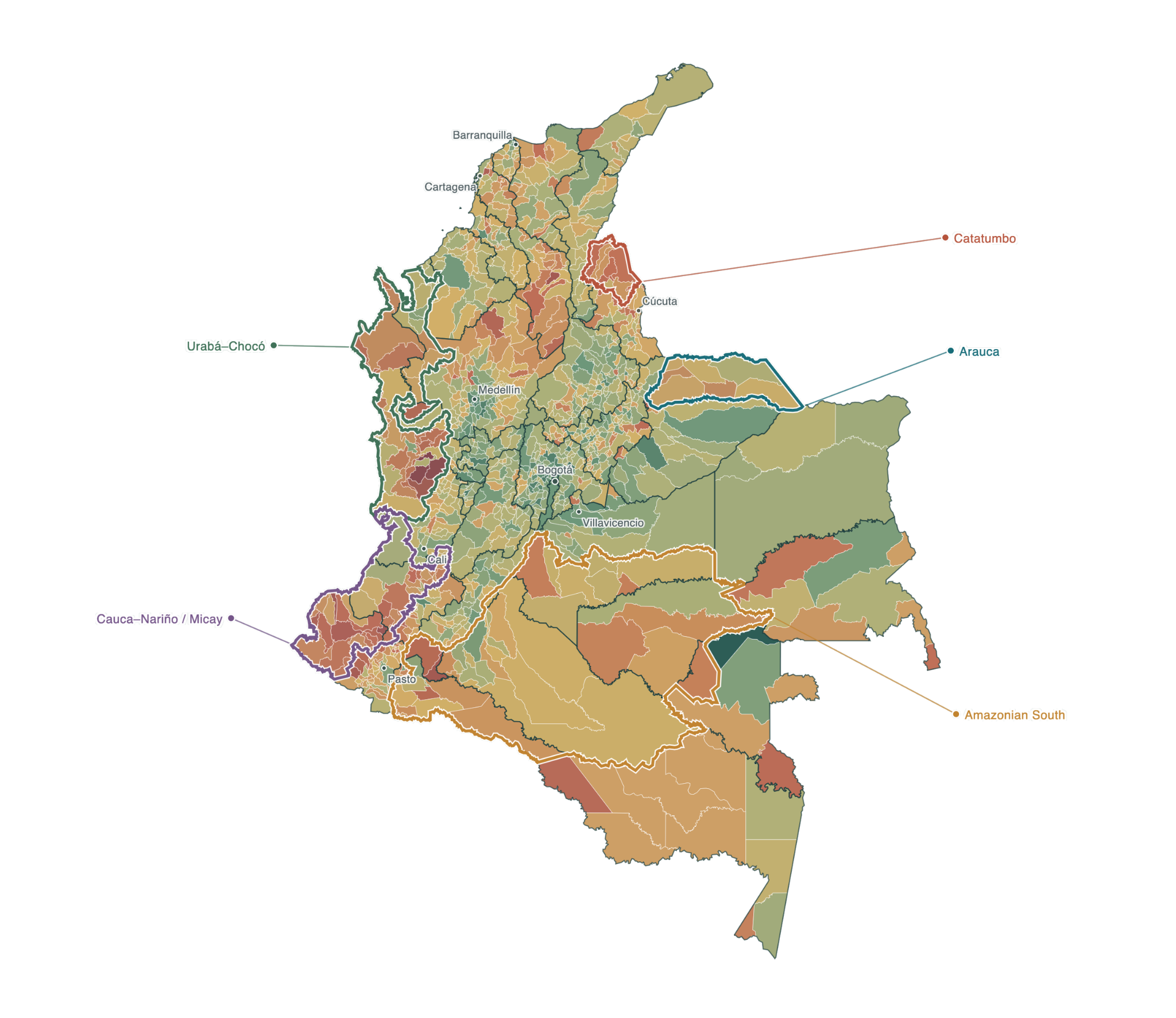
State Presence Index by municipality, shaded from red (weakest) to green (strongest), with the five theaters outlined. Source: Analysis of public Colombian data.
Setting 60 as the rough threshold for “governance” would place 67.9% of the population as living under state control – but covers only 29.5% of the land. Overlaid are the five theaters of interest described above; their component municipalities all score well below the national average (50.3), with Catatumbo at a mere 31.2.
This map is closer to the measure that should define American success in Colombia. The objective is not a higher price on the streets of Miami, nor a longer list of dead commanders (though the former will come, and the latter will help). A reduction in cocaine exports, violence, human trafficking, and foreign operability will follow – in a far more effective and durable way than by merely spraying coca fields.
III. The Way Forward: Tactics and Technology
Framing Colombia’s war as a regional rather than organizational problem strips away much of the conceptual baggage the United States has accumulated over twenty years of counterinsurgency in the Middle East, and returns the problem to something much older and simpler: clear, hold, build. This is, at its core, a traditional military challenge of taking and holding territory, then filling it out with permanent infrastructure – not necessarily the complex, socially-centric COIN problem it is so often presented as. Just as the Panamanian Darien presented a template closer to the Banana Wars than Vietnam, Colombia presents a paradigm closer to the Indian Wars than to more recent theaters.
Edward Luttwak, in his critique of modern counterinsurgency doctrine, argued that Western militaries had come to mistake counterinsurgency for a kind of armed good-governance program; and that historically successful counterinsurgents won instead by making it unmistakable who held power, and – crucially – that they intended to stay. Colombia does not need to build a state from whole cloth, as the United States tried to do in Afghanistan. It already has a functioning, democratic government that controls two-thirds of its population. What it lacks is the ability to extend that government’s reach into the other seventy percent of its land, and thus to prevent “alternative governance” from illicit use of that land and exploitation of its residents.
Historically, this has eluded possibility – hence the cycle of fighting and then negotiating without forward progress. It has long been a fact of Colombian life – since its independence, but particularly since the beginning of its modern insurgencies – that military presence in a given area will be temporary and incomplete. Even during moments of great vigor (such as under Uribe), the military inevitably runs out of money or political will before the insurgency is fully destroyed and the state fully entrenched. And upon the government’s exit, armed-group remnants and successors can easily take advantage of the circumstances that allowed them to operate in the first place.
The objective of a successful Colombian military effort, then, should be to force an attritional conflict on its own terms, while expanding rural capacity. If, by passive measures, the Colombian state can force insurgents to contend with it in order to perform basic functions, the military will win the conflict; thus the ideal war is one of attrition.
The state necessarily has more resources than the insurgents, but if it cannot force them to burn their assets faster than the state burns its own, the point becomes moot. In the short term, high-tempo raids, bombing runs, and aggressive campaigns of suppression can inflict massive damage upon these groups. But after this first phase of intel-based hits is completed, both sides will settle into an unsteady equilibrium – and here it is cheap, passive, attritional capacity that wins the conflict in the long run, and allows the state to expand its geographic reach at a sustainable pace.
Here, Peru under Fujimori is the case that deserves the closest study. In fact, it stands out as the only successful direct comparison in recent history. The Shining Path was ultimately defeated by a strategy that ground down its operational ability over years. The state steadily denied its movement, supply chains, recruiting pipelines, and the cooperation of the rural population, while intelligence work picked apart its leadership. The insurgents were forced to fight simply to keep functioning; and this is where an insurgency fails against a state military actor. This attritional dynamic is precisely what Colombia needs to create, and the Peruvian experience should be a central reference point for Colombian and American planners alike.
Tied deeply to attritional capacity – and particularly important in the Colombian case – is persistent visibility. In much of Colombia, insurgents are the visible fount of legitimacy and governmental services: taxation, dispute resolution, credit, and even public utilities (ambulances, etc.); they supplant the state where it barely reaches itself. A recent UIAF study found that rural Colombians are more than willing to use legitimate services (i.e. those provided by the government) – but those services are simply not visible to them, and law enforcement is either nonexistent or suppressed into practical uselessness. Thus any strategy must prioritize being seen by people in rural areas, which starts with the military. The army’s continuous, visible presence is step one in asserting Bogotá as the legitimate authority, with a perceived monopoly on violence.
1. Helicopters as a Counterinsurgency Tool
With these criteria in mind – attritional capacity and persistent visibility – we can judge aspects of Colombian doctrine and strategy to find points of failure before they occur. The first obvious red flag is the centrality of helicopter operations to counter-cartel operations. This aspect of their force posture is largely an American export, with donations of Black Hawks having made up a central pillar of Plan Colombia. From a US perspective, it made sense: operating over massive areas with adverse terrain and few roads is an ideal job for a helicopter-centric force. It was (and is) precisely how the United States would fight Colombia’s war.
But today – and at any given time – less than half of Colombia’s rotary-wing fleet is airworthy. Helicopters are an incredible tool for a nation with strong ground force-projection capacity, and an even stronger logistical and maintenance apparatus; Colombia has neither. The Colombian military in general lacks maintenance capacity, and struggles to afford the spare parts needed to keep the fleet at full readiness. In a war of attrition, the government will run out of money to maintain this strategy before the insurgents run out of willingness to maintain operations.
Further, guerrillas in dense jungle are able to hear a helicopter from quite far away – and changes in birdsong even before that, as loud birds go quiet and quiet birds become loud. This gives them an opportunity to slip away or prepare an ambush, which in the age of drones can be more effective than ever. The massive expansion of insurgent drone capacity means that, at scale, they increasingly own low-altitude airspace, and can attack helicopters and gunships during the early phases of operations. The dramatic failure of a helicopter-borne operation due to drone ambush is, at this point, a dark inevitability. A Black Hawk Down incident would of course strike a strategic blow to the Colombian state – but it would also gut public confidence in the Espriella program, and in US support of the effort, at a critical moment.
The import of helicopter centrality to Colombian warfighting is one symptom of a larger trend: a fixation on high-tech, high-speed, and high-cost tools, at the expense of developing more basic capacities for taking and holding territory. An initial, US-style search-and-destroy package with intel-based decapitation strikes is valuable – and is exactly what the current offensive should be using. But instead of exporting the most advanced pieces of American military tech and tactics, the US should work with Colombia to build a more robust, baseline capacity for territorial dominance. This investment and skill transfer should focus on persistence, cost-effectiveness, and visibility as the basis of legitimacy.
2. Rethinking Riverine Warfare
Here, it is worth looking at a more promising “backbone” for Colombian military efforts: its riverine navy. In Colombia’s peripheral areas, rivers are the principal arteries of movement, commerce, supply, and infrastructure – both legitimate and illicit. The same rivers that connect isolated towns provide armed groups with cheap, poorly-observed routes for the movement of men and materiel: 78% of all cocaine trafficking routes are riverine, and the vast majority of illegal gold-mining equipment is moved along inland waterways, rather than by road. Beyond smuggling, rivers are how armed groups govern: they move personnel, collect intelligence, tax traffic, and connect otherwise isolated local economies. In many parts of rural Colombia, the river is central to all life – making control of those rivers a crucial strategic objective.
Fittingly, Colombia’s current brown-water force is one of the most advanced of its kind, with more than 100 dedicated hulls of various sizes – from 22-foot Piranha assault craft to the 132-foot PAF-P command ship. Its force posture and doctrine is clearly derived from an American Vietnam War program: the Mobile Riverine Force. This model – built around a mothership-centric “riverine armada” as a massed unit of strike capacity, with LPRs as secondary C2 and fire support for smaller assault boats, not unlike a carrier strike group at sea – is the result of decades of cooperation and cross-training between American and Colombian forces, a clear descendant of the successful MRF model.
On paper, this force should satisfy our goals of low-cost attritional capacity and visibility. However, the relevant doctrine demonstrates another misallocation of American expertise. The MRF model, as effective as it is, was built for the specific purpose of finding and destroying formed enemy combat units in the riverine environment – and this is not the problem Colombia currently faces. They have built offensive maneuver capacity, when what they need is interdiction and control.
Instead, Colombia should be encouraged to look to a different Vietnam War model: Task Force 116, or GAME WARDEN. This program, built around pairs of boats on distributed, persistent patrols, more precisely fits Colombia’s current military problem set: disrupting enemy logistics, denying insurgent use of crucial waterways, and projecting visible force deep into rural areas. A complete overhaul of brown-water doctrine and force posture would be one of the highest-impact possible changes for the Colombian counterinsurgency effort.
PAFs should be reconfigured as tenders, with pairs of adapted LPRs on long patrols as the core unit of the force. The current fleet of LPR-40s, alongside newly-fielded equivalents – tended by overhauled PAFs – should become the backbone of territorial reclamation efforts, offering a powerful combination of interdiction, rural persistence, and state visibility. The goal here is sustained presence, broad coverage, and maximal intelligence, rather than armada-type brown-water offensives: to impose unpredictable costs and risks upon insurgent movement along the rivers in a cheap and sustainable fashion, and to maximize the visibility of central-government authority in rural, contested areas. This model achieves both.
Their current force is built to assault targets on the rivers, but intelligent reform could offer real ownership of them – or at the very least, significant denial of insurgent use, forcing them to resort to slower and more expensive overland routes or assume serious risk. This is exactly the kind of investment that offers immediate and durable gains in military (and state) capacity, by forcing insurgents to make unpalatable decisions that wear down their operational ability over time.
It is also an area with immense potential for US study – considering our relative lack of permanent brown-water expertise, compared to the importance of riverine theaters in potential Asian conflict theaters. Partnering closely on Colombian riverine reform – as with the maritime interdiction lessons of Southern Spear and Pacific Viper – would rebuild that expertise. A serious effort to deter China – in which half of the population lives along the Yangtze and Yellow River basins alone – requires brown-water expertise, both in terms of doctrine and engineering; and there is no better place to develop it than in Colombia.
3. The Drone War
A similar paradigm appears on the drone warfare front. Right now, Colombia faces a site security problem at massive scale: everything from police stations to politicians’ houses to bridges and road junctures are at risk of complex drone attack. Any attempt to expand state infrastructure in a contested area – from a military installation to basic administrative buildings – is precisely what insurgents can easily punish, at little cost and no risk to themselves.
Ultimately, drone warfare – from Ukraine to Colombia to hypothetical future Taiwan Strait scenarios – is an economic phenomenon, and changes on the battlefield are induced by changes in the underlying economics. Looking at the drone war from the economic perspective reveals two conclusions. First, drone attacks offer insurgents a zero-risk, inexpensive way to inflict serious damage on government forces, and to boost their image of omnipresence. To this end, drones, parts, and munitions are prolific and cheap; operators, however, are not. Any C-UAS solution built around inflicting risk upon operators – i.e. doctrine that uses RF triangulation and a rapid QRF, or counter-launched drones – as well as a broader law enforcement strategy of prioritizing their capture, attacks the only scarce resource in the insurgents’ inventory, and changes the calculus so as to discourage drone action.
Skilled operators have already been identified as the highest-value individual targets in Ukraine, with incentives built around their capture; the same applies here. Additionally, US connections to Ukrainian military intelligence could help Colombian authorities develop a shortlist of people who enrolled in drone schools in Ukraine before returning to Colombia, to help identify potential armed-group operators – exactly the scarce human capital worth targeting, as a way to help flip the one-sided exposure of the current drone threat.
Second, given the country’s financial situation and threat matrix, the only viable solution to site security is the domestic production of interceptor drones. Jammers are easily outmaneuvered by fiber-optic drones, a technology already picked up from Ukraine and used in-theater; DEW systems are far too expensive for the sheer number of sites that need coverage; other kinetic solutions share the problem, and/or are too nascent. Interceptors are relatively future-proof, and domestic production would make each shoot-down (and magazine resupply) cost-effective. It also gives American drone firms the opportunity for a live-fire environment in which to iterate designs. The US can subsidize this, provide tech and training, and reap benefits from American startups gaining experience in a hot environment.
US involvement in Colombia is already producing a shock-and-awe, intel-first COIN offensive. This is promising, and will significantly help Colombia and the US achieve their mutual goals. However, the Colombian problem in the meantime is building the capacity for a strategy that makes cartel suppression a permanent, durable state of affairs. Denial of insurgent logistics, hardening of both sites and doctrine against the new drone threat, and a focus on winning the long war will make that happen.
IV. The Way Forward: Durable Policy Solutions
Military reform can make it possible for the Colombian state to take and hold its territory. The “build” phase depends in large part on far broader incentives. Here, the United States has more direct leverage than anywhere else, and much of it costs very little.
The principle is the same one that drove the transformation of the Darién. I argued in The Second Southern Border that the existence of “lawless frontiers” in our hemisphere is an active policy choice, not an inevitability; the Darién stabilized when American policy stopped rewarding the conditions that made it lawless. Colombia’s periphery can follow the same path – if the incentives are changed to support it.
1. The International Community & the Incentives Problem
On a policy level, Colombia has long faced a particular incentive problem: the necessary but unsavory work of reclaiming territory – of increasing actual state legitimacy – tends to decrease perceived state legitimacy within the “international community” – and thus, in a roundabout way, access to capital. “State violence,” as a decontextualized thing, leads to a poorer assessment from the World Bank, OECD, etc., and thus a lower credit rating. In this way, the state is incentivized to remain generally helpless; or at least not incentivized to improve its situation. Bushnell’s history shows a version of the same dynamic playing out in the 1980s, when a government that did try to crack down on the guerrillas found itself the subject of growing unfavorable attention from international human rights organizations.
Bolstering this problem are a number of international organizations which have ultimately acted to undermine Colombian sovereignty, and to incentivize helplessness at the local-government level. Geneva Call, the Washington Office on Latin America, Peace Brigades International, PAX, the Norwegian and Danish Refugee Councils – all of these organizations have contributed to the perverse-incentive problem, and in many cases have negotiated with insurgents on behalf of a disembodied “international community” – thus further delegitimizing the Colombian state within its own borders.
This is the same pattern observed in Darién. There, the international-aid NGO complex built a parallel, formalized pipeline for irregular migration that empowered the Gulf Clan and destabilized the region, all while presenting a public front of humanitarian inevitability. The broader failure mode is structural: NGOs operating in contested regions are fiscally inefficient, answer to donors rather than to local governments, and have a perverse incentive to sustain the very conditions that justify their work. The US under Trump’s second term has made incredible progress at delegitimizing and defunding the broader NGO complex, but Colombia should be encouraged to do so as well – and the UN and ICC must be kept away from Colombian affairs.
Further, the United States is in a unique position to alter the incentive problem facing Colombia: by tying access to infrastructure capital to concrete territorial reclamation. The sheer amount of extortion payments levied by armed groups should, upon the Colombian economy’s gradual relief from them, open up attractive investment vehicles within it. The US could tie investment on favorable terms – perhaps through the DFC, alongside multilateral guarantors like the World Bank’s MIGA, and with American private partners – to the meeting of concrete territorial-control metrics. The State Presence Index described above is one model for what those metrics could look like.
In terms of making that investment possible, the highest-impact step in this direction is land formalization. Colombia’s rural planning agency estimates that roughly 54% of rural parcels are held without formal title. Untitled land cannot be mortgaged, developed, insured, or properly bought and sold; it is invisible to the state, and its ownership lacks an enforcement mechanism. This has been a consistent problem in rural Colombia, leveraged by armed actors since La Violencia. Funding titling and cadastral efforts – a relatively cheap and highly visible form of American assistance – would do more than almost anything else to allow capital to flow to rural Colombia, from domestic, US, and other international firms. Risk guarantees can close the remaining gap; there are already successful case studies in the relevant regions. In 2022, MIGA guaranteed a $103.7 million JPMorgan loan to FDN, Colombia’s state infrastructure bank, to finance Puerto Antioquia – a new port on the Gulf of Urabá. In 2025, MIGA backed a further $228.9 million JPMorgan loan to Barranquilla. The DFC helped finance the Rumichaca-Pasto highway in Nariño, where $250 million in development financing mobilized the rest of a nearly $1 billion project. Scaled up and explicitly tied to territorial-control benchmarks, this model – American private capital, de-risked by public guarantees – is exactly how US investment can follow, and reward, the state’s return to los territorios.
This flips the existing incentive structure on its head. Instead of a government penalized for fighting, Colombia would have a government – and, crucially, regional governors and mayors – rewarded for every municipality that comes under true state control. Roads, bridges, improved electrification, and logistical hubs built in newly-secured regions would in turn reinforce state presence, making the gains harder to reverse.
2. Disincentivizing Coca Production
On the narcotics front itself, coca eradication – whether by spraying, bombing, or manual removal – is not a bad thing. But on its own, it is insufficient to discourage coca cultivation in Colombia, let alone in general, and primarily has a psychological or moral value. Crop destruction has very little effect on consumer prices or on armed-group finances, and when pressured, cultivation and processing simply shift elsewhere. The more important goal is to give the typical small farmer a better option. Right now, coca is comparatively easier to bring to market than most other crops: it’s simple to grow, does not require any special equipment to prevent spoilage, and a well-developed single-buyer market handles the logistics. Legitimate alternatives require substantial investment in labor and technology: namely, in the infrastructure to get perishable goods to market, like cold storage and refrigerated trucks. The United States could encourage or subsidize this: substitute-crop infrastructure – rather than substitute-crop cash payments, which have been tried in the past and proven flawed – in regions where the state has newly established control. A cold-chain logistics network, for example, is also a state-presence network; it brings improved roads, formal contracts, and wider bankability with it.
3. Cracking Down on Finances
Instead, the financial side of the armed groups’ business is where they are most vulnerable, and least attacked. Their money moves through three main channels: physical transfers of hard cash and gold, friendly or captured banking institutions, and international laundering networks. Attacking these channels – the shadow-banking system of cash, laundering, mining, and precious-metal transfers – does significantly more damage than broad-spectrum attacks on coca production, because it hits capital that is far scarcer and harder to replace. Illegal gold deserves particular attention, as both a revenue source in its own right and a laundering mechanism. Like cocaine, it moves overwhelmingly by river, and then in most cases crosses at least one national border. Riverine/littoral interdiction and financial intelligence are, in this sense, two halves of the same campaign.
Further contributing to the cartels’ ease of financial operations is the fact that key aspects of the Colombian state – intelligence, law enforcement, personnel management, etc. – struggle immensely with basic functions of large-scale data management. The financial intelligence apparatus (UIAF), for instance, has a significant backlog of paperwork that has never been digitized, slowing down investigations and prosecution. These agencies would benefit immensely from American consultants, sent via a sort of exported Tech Force model, and with some capital to bring US firms to the table. Bringing Colombian SIGINT, data analysis, AI integration, and hosting into the modern age (for example, AI-powered conversion of unstructured records into structured data for better financial-investigative ability) presents a relatively low-cost, high-impact boost to state capacity and anti-cartel action. This is a cheap, fast, and durable way to build lasting institutional reliability.
The same logic applies across the board. Assistance that builds Colombian capacity – in defense procurement, infrastructure investment, drone production, data – strengthens Colombian sovereignty and ties that sovereignty to American partners. This is where Colombia’s war intersects with the broader contest for influence in the hemisphere. Under Petro, Colombia formally joined China’s Belt and Road Initiative in May 2025, and Chinese firms already sit at the center of major projects like Bogotá’s first metro line. Beijing’s ambassador has been explicit that further Chinese investment now depends on the choices of the new government, though Espriella’s distancing from BRI is promising. As in Panama, the Chinese playbook only requires Colombia to remain the kind of state that needs what China is offering: institutionally thin, financially exposed, and reliant on outside actors to build what it cannot build itself. Every dollar that helps Bogotá govern its own territory is therefore both degrading the armed groups and closing the openings for Chinese leverage in our backyard. That makes the Countering PRC Influence Fund, funded at $400 million in the FY2026 appropriations, a natural source for any aspect of this program: land titling and cadastral modernization, the data infrastructure of the UIAF, etc.
Finally, none of this works without a stable and optimistic political equilibrium that allows Espriella’s coalition to continue the fight. The single greatest historical threat to Colombian counterinsurgency has not been the armed groups’ military strength – which is unimpressive in itself – but the state’s political exhaustion. Colombian presidents are limited to one four-year term, making the fight against cartels particularly vulnerable to political whiplash. The United States can help directly, by making sure the benefits of partnership – investment, trade, security – arrive fast enough to be felt in the media and at the ballot box.
V. Conclusion: Winning the Long War
Colombia is the most important security partner the United States has in South America, and the country where the goals of the Trump Corollary – the destruction of transnational cartels, the stability and prosperity of friendly governments, and the exit of foreign influence from our hemisphere – converge most directly. It is also the southern end of the same corridor that runs through the Darién; every kilo of cocaine interdicted off the Panamanian coast, and every smuggling route denied through the Gap, begins as a problem of Colombian governance (or the lack thereof).
The new Colombian government, with American support, has opened the most promising offensive against the country’s armed groups in a generation. The first two months have been remarkable. But Colombian history holds a long record of offensives that succeeded and then stalled – followed by the resurgence of armed groups exploiting the same set of conditions, because the state was never quite able to fill the gap and hold or develop its own land. The argument of this report is that the United States should help Colombia build the capacity to stay: to do the unglamorous work of fixing its 200-year-old structural weaknesses, in order to defeat the possibility of another insurgency ever seizing regional power. That means reframing the war around territorial dominance, and reframing American security aid around state presence rather than drug prices or hectares of coca eradicated. It means investing in attritional military tools that make state presence visible and unavoidable; and it means using American economic and diplomatic leverage to reward the Colombian state for governing its own territory, rather than allowing the broader international community to penalize it.
There is a dividend in this for the United States that extends far beyond Colombia itself. The problems at the heart of Colombia’s war – cheap, hyper-adaptive drone attacks against fixed infrastructure; brown-water interdiction and denial in contested river systems; and operating a complex offensive under constant information exposure against a dispersed adversary – are the same problems America is likely to face in future conflicts, from the littorals of Southeast Asia to any other theater in the Western Hemisphere. Colombia is fighting that war now, with a rare moment of focused political will to see it through. Helping them win that fight is a rare opportunity to build American expertise in emerging – and returning – frontiers of war, to the benefit of a nation in our own backyard.
Bushnell called Colombia a nation in spite of itself: a country that endures and even thrives despite its violence and limited governmental capacity. The goal now is to make it a state in spite of itself: a truly self-governing hemispheric ally, freed of transnational cartels and armed extortionists. The fight to do so may outlast Colombia’s current administration, but its goals are wholly achievable – if the fight is framed correctly, and if the United States helps Colombia build the capacity to win not just the next battle, but the long war required for lasting change.
This research was made possible by the DARC Fellowship program.
Special thanks to our hosts and contacts in Colombia for their hospitality and input on this research, especially Isaac Beltran for his interview; to Bridgekeeper Inc., for intelligence analysis of Colombian regional dynamics; and to Edward Luttwak, for his feedback on Latin American counterinsurgency campaigns.
Selected Sources / Further Reading
Arjona, Ana. Rebelocracy: Social Order in the Colombian Civil War. Cambridge Studies in Comparative Politics. Cambridge: Cambridge University Press, 2017.
Bushnell, David. The Making of Modern Colombia: A Nation in Spite of Itself. Berkeley: University of California Press, 1993.
Colombia. Armada Nacional. Dirección de Doctrina Naval. Manual de Operaciones Fluviales. 5th ed. ARC T3.4-1.1. Bogotá, D.C.: Armada Nacional, 2025.
Eddy, Paul, Hugo Sabogal, and Sara Walden. The Cocaine Wars. New York: Bantam Books, 1989.
Gutiérrez Sanín, Francisco. Clientelistic Warfare: Paramilitaries and the State in Colombia (1982–2007). Oxford: Peter Lang, 2019.
Marolda, Edward J., and R. Blake Dunnavent. Combat at Close Quarters: Warfare on the Rivers and Canals of Vietnam. The U.S. Navy and the Vietnam War. Washington, DC: Naval History and Heritage Command, 2015.
Rabasa, Angel, and Peter Chalk. Colombian Labyrinth: The Synergy of Drugs and Insurgency and Its Implications for Regional Stability. MR-1339-AF. Santa Monica, CA: RAND Corporation, 2001.
U.S. Government Accountability Office. Colombia: U.S. Counternarcotics Assistance Achieved Some Positive Results but State Needs to Review the Overall U.S. Approach. GAO-19-106. Washington, DC: Government Accountability Office, December 2018.
Wainwright, Tom. Narconomics: How to Run a Drug Cartel. New York: PublicAffairs, 2016. Chapters 1, 3, and 5.
